

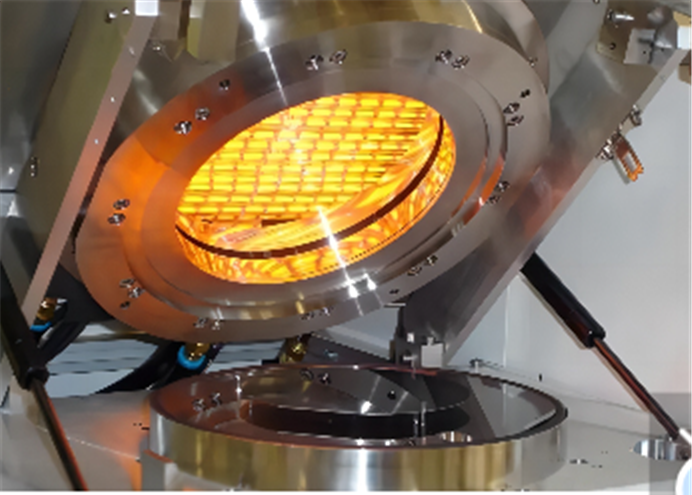
On the 300mm line, trapped moisture after cleaning is the quiet yield hit you don’t see until it’s too late. It works its way into the photoresist stack, throws off the thermal budget, and shows up as footing or T-topping after exposure. The wafer moisture removal heater lamp was built to stop that drift at the source. What matters under the hood We run short-wave halogen quartz lamps with fast-response filaments, so the heat lands where it needs to—quick and localized. The spec is ±0.1°C wafer-level uniformity across the bake zone, which is exactly why soft bake and hard bake profiles stay on the recipe, shift after shift. The unit fits Class 1–100 cleanrooms, built with low-outgassing materials and a design that keeps particle generation at zero. Output is stable from 200°C to 450°C with tight repeatability, so dehydration bake and post-apply stabilization happen without thermal overshoot. Why it holds up on the floor You need the bake step to behave the same at 02:00 as it does at 14:00. This lamp delivers that discipline: strip off surface moisture, stabilize the resist before exposure, then lock the image in after develop. The payoff is fewer rework lots, less scrap, and CD control you can count on. Energy use drops because it ramps fast to setpoint and transitions cleanly from idle to process. It runs 24/7 without unplanned downtime. As a direct equivalent to OEM heater lamps, it drops straight into existing coat/bake tracks—no need to requalify the whole module. What to watch for Installation is straightforward on standard fixtures, but alignment matters. Keep the lamp within the specified focal offset; otherwise you’ll see a hot-edge signature. Handle the quartz right—no fingerprints, no solvents on the envelope—and verify chamber emissivity and reflector condition on the first run. There’s a short burn-in window while output stabilizes. After that, lock the setpoint and let the process run.