
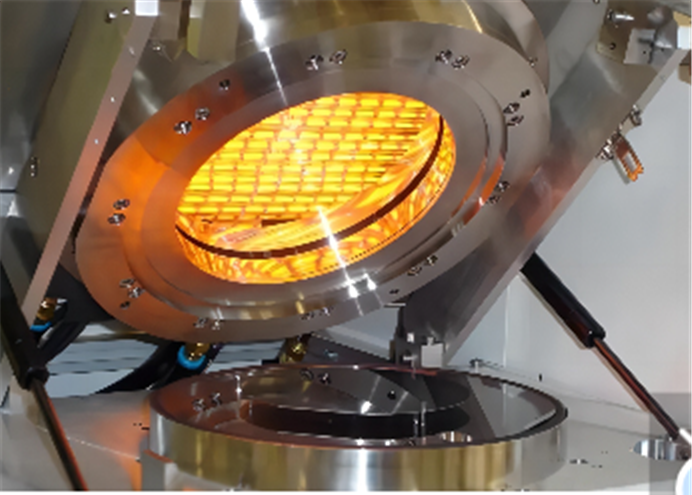
On the fab floor, temperature stability isn’t a “nice to have.” It’s a line requirement. A drift during photoresist processing—even a few tenths of a degree—can throw off CD control and wipe out a lot. Old-school heaters tend to miss the mark: uneven profiles, particles, and the kind of downtime that shows up right when you can least afford it. We built a maintenance heater for semiconductor tools to meet the thermal demands of advanced wafer manufacturing. What matters under the hood We use a quartz-based emitter with short-wave infrared (NIR) response. It heats fast, right where you need it, and settles quickly. Across the bake surface, wafer-level uniformity holds at ±0.1°C, which protects photoresist yield in both soft bake and hard bake. It runs in cleanroom Class 1–100 without adding particles, and we verify that with in-situ particle monitoring. And when the line is running 24/7, output repeatability stays consistent—cycle after cycle, the temperature curve lands the same. Why this works where it counts Lithography and photoresist processing leave you with a tight thermal budget. Hit the same soft bake and hard bake temperatures every time, and you get tighter linewidth control, fewer defects, and etch profiles that behave predictably. The fast response cuts bake time without overshoot, so tool throughput improves. We only heat what needs heating, which lowers energy use. Reliability is built in to cut unplanned downtime—fewer stops, fewer interventions, and fewer scrapped wafers. What to plan for on install Installation comes down to matching the tool interface and thermal load. The heater has to be tuned to the specific hot plate geometry and exhaust flow. Expect a short commissioning window to lock in temperature setpoints and confirm the uniformity map. Once it’s calibrated, the unit runs with minimal adjustment—as long as thermal coupling and cleanroom airflow stay exactly where they were.